


Charlyne at a glance
- Who
- Charlyne, from France
- Studies
- Spanish at Université Marie et Louis Pasteur (Besançon)
- Wants to be
- A Spanish teacher
- Internship
- At Hablandis, in education
- Length
- Six months, September to February
- Where
- Rincón de la Victoria (Málaga)
- Program
- Spanish + Professional Development
Charlyne is French. She studies Spanish at Université Marie et Louis Pasteur in Besançon, and she wants to become a Spanish teacher. She is doing a six-month internship at Hablandis, in Rincón de la Victoria (Málaga):
- she supports the teachers;
- she takes part in the school’s activities;
- she helps with admin tasks.
She arrived with a good foundation from her studies, but speaking was hard. Now she speaks Spanish all day.
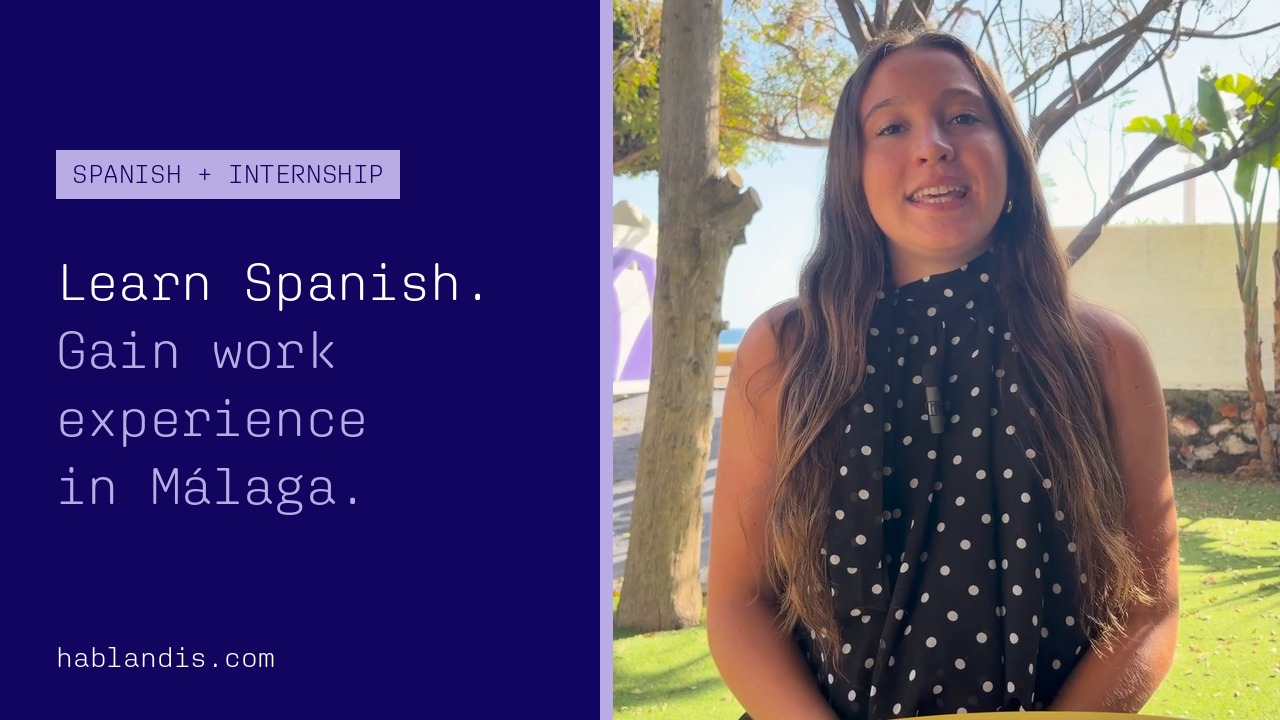 YouTube
The video is 2:17 long. Charlyne speaks Spanish, with subtitles in English and Spanish.
Video chapters
- 0:00 Meet Charlyne
- 0:19 Her internship
- 0:39 Learning to speak Spanish
- 0:56 Friends, sport and trips around Andalusia
- 1:29 Sharing food and cultures
- 2:00 More than a language
Studying Spanish to teach it “I study Spanish at the University of Besançon,” Charlyne says. “And I’d like to become a Spanish teacher.”
If you want to teach Spanish one day, spending a few months inside a Spanish school means seeing the job from the inside: how a school day is organized, how students are supported, and everything that happens outside the classroom.
What she does in her internship “I’m doing my internship at Hablandis, in Rincón de la Victoria. I started in September and I’m staying until February.”
Her day has three parts. “I support the teachers and take part in the school’s activities. I also help with admin tasks.” That way she gets to know the classroom, school life and the admin side, the part you never see from a student’s desk.
Her internship is in education, one of the ten fields where we find internships with Spanish + Professional Development.
From understanding to speaking “When I arrived in Spain, I had the basics from my studies, but speaking was hard for me.”
This is the hardest step for anyone who learns a language at home: you can understand it and write it, but you don’t dare to speak it. There is no shortcut. You have to use it for many hours a day, with real people, because you need to.
Charlyne puts it in one sentence: “I’ve improved a lot: speaking is easier now. Because I speak Spanish all day long.”
Friends, sport and Andalusia “I do lots of things outside school. For example, I really like sports.” This fall she ran the Carrera Urbana Ciudad de Málaga, the city’s urban race.
She has made friends too: “I have friends from all over the world, especially from Latin America. Two friends from Paraguay and two from Colombia.” So the Spanish she hears every day is not only the Spanish of Spain, but also the Spanish of Latin America.
With them she has climbed up to Gibralfaro Castle in Málaga, done a via ferrata, and traveled to Córdoba and around Andalusia.
On Fridays, a dish from every country There is a school tradition Charlyne especially likes: “Some Fridays we all eat together, and every student and every teacher brings a typical dish from their country. And that way we share our cultures.”
More than a language “For me, learning a language isn’t just about studying grammar. It’s also about discovering the culture and talking to people.”
I came here to improve my Spanish, but I’m really learning much more than a language.
Want to do an internship in Málaga while you learn Spanish? That is what we do with Spanish + Professional Development: – You choose the field. Tell us what you study and where you’d like to do your internship: education, business, hospitality and tourism, health and social care, tech, culture, sport, the environment or non-profits. – We find your internship to match your profile, and your accommodation if you need it. We support you throughout your stay. – Spanish class in the morning, starting at your level. The rest of the day, your internship. – At the end, you take home your Spanish course certificate and an internship report for the recognition of your training credits. – You can come with Erasmus+, with a grant from your university or school.
Get your quote or write to us at info@hablandis.com.
We ♥ to talk.
FAQ
Can you do an internship at a Spanish school?
Yes. Education is one of the fields of Spanish + Professional Development: schools, language academies and nursery schools. Charlyne is doing her internship at our own school.
What does an intern do at Hablandis?
Charlyne supports the teachers, takes part in the school’s activities and helps with admin tasks. Internships are found based on what you study and what interests you.
How long can the internship last?
It’s up to you and your studies. Charlyne is staying for six months. On the program page you’ll find stories of two months and of two weeks.
Do I need to speak good Spanish to do an internship in Spain?
It isn’t required, but it’s recommended: the more Spanish you know, the more you’ll get out of your internship. Charlyne arrived with the basics from her studies. Speaking was hard, and a few months later she speaks Spanish all day.
What do I get at the end?
Your Spanish course certificate and an internship report for the recognition of your training credits.
Full transcript (translated from Spanish)
Hi, I’m Charlyne. I’m French, and we’re at Hablandis. I study Spanish at the University of Besançon, in Burgundy, France. And I’d like to become a Spanish teacher. I’m doing my internship at Hablandis, in Rincón de la Victoria. I started in September and I’m staying until February. During my internship, I support the teachers and take part in the school’s activities. I also help with admin tasks. When I arrived in Spain, I had the basics from my studies, but speaking was hard for me. And I’ve improved a lot: speaking is easier now. Because I speak Spanish all day long. I do lots of things outside school. For example, I really like sports. I have friends from all over the world, especially from Latin America. Two friends from Paraguay and two from Colombia. We went to Málaga, to Gibralfaro Castle. We also did a via ferrata. And we also went to Córdoba and around Andalusia. For me, learning a language isn’t just about studying grammar, it’s also about discovering the culture and talking to people. For example, some Fridays we all eat together, and every student and every teacher brings a typical dish from their country. And that way we share our cultures. I came here to improve my Spanish, but I’m really learning much more than a language.
More stories: Connor from Boston · Every year, we meet here


